After learning about the atrocities of the Rape of Nanking, I can see how widespread the brutality of the Axis Powers was. The soldiers seem to be able to perform the most despicable deeds without being troubled by there consciouses. I also wrote about this in my journal and the one thing that this really makes me wonder is if the civilians of the same country as the military that conducted these activities would have wished their enemies to suffer as badly as they did. Was the cause of this brutality a result of gruesome training given to the Japanese boys by the government, or is that just the mindset people get when they go to war?
I wonder about the causes of the actions of the Japanese as well as the German soldiers, because we are led to believe that they were some of the most evil beings imaginable. However, the propaganda of the Axis Power nations probably was designed to cast the troops of the Allied Powers in a similar light. What kind of atrocities were committed by our side that we have never heard about? I ask this because I have heard a few stories of terrible things that the United States did to civilians in the Vietnam War. This is surely downplayed by the government because it was so recent, and many veterans remain scarred by what happened then. Hearing about events such as the Rape of Nanking makes me wonder if other countries tell similar terrible histories about the United States. I know there are plenty of people in the world who hate the United States, and maybe they have a better reason than our history books want us to know. Of course, maybe it is also through exaggeration.
Tuesday, April 13, 2010

Sunday, April 11, 2010
Physics and Philosophy
I found it interesting how both physics and philosophy seemed to "fall apart" at the same time. Physics, always trying to delve for a more fundamental understanding of the universe, led to the realization that we have no idea why atoms behave the way they way they do. Before that, there had been great confidence in the fact that physics seemed to be able to solve any problem that society faced. The new physics also led to terrible new discoveries. The ability to split the atom led to the creation of the atomic bomb. This also led to the ability to harness nuclear power for peaceful energy, but the results of the Manhattan Project had caused people to fear and distrust physics.
Philosophy also grew more confusing and more threatening at the same time. Freud was the most famous and most controversial psychologist of the time. His views were not so widely accepted as those of physics however, even though the new views of physics were basically saying we knew nothing. A much less popular -- and in my opinion much less valid -- science, psychology seemed to be following the trends of physics. This might be because the overall view of the universe changed with physics. I think it was this sort of thing that gave rise to the modern trend of agnosticism.
Philosophy also grew more confusing and more threatening at the same time. Freud was the most famous and most controversial psychologist of the time. His views were not so widely accepted as those of physics however, even though the new views of physics were basically saying we knew nothing. A much less popular -- and in my opinion much less valid -- science, psychology seemed to be following the trends of physics. This might be because the overall view of the universe changed with physics. I think it was this sort of thing that gave rise to the modern trend of agnosticism.
Connection Across Time
After exploring the different forms of art and music of the Age of Anxiety, I realize that artistic movements are often limited in whom they appeal to, just like the cultural transformations during the Renaissance were restricted to the lifestyle of the upper class. Old movements still live on today. As I said before, the music that was introduced at this time broke the rules of composing that existed before. However, not all music today breaks these rules, or at least not so many rules. New movements seem only to pile on top of old ones. Artists also probably try to copy some styles of previous times. It is like part of the way humans learn by passing knowledge, and art, down through time. There are still people today who practice dadaism, but there are certainly a lot more people who don't. As new things are developed, they don't take over whatever field they are a part of. They simply add to it in a way that allows others to specialize according to their own personal preferences.
There is still music played today that was written by Beethoven and Mendelssohn. While there are new forms of music being created today, I certainly do not have any knowledge of what these new things might be. The music I listen to may be written during the current time, but the basic form of the music is fundamentally the same as older music. As Dali said, people are not always ready to be exposed to the new art of the day.
There is still music played today that was written by Beethoven and Mendelssohn. While there are new forms of music being created today, I certainly do not have any knowledge of what these new things might be. The music I listen to may be written during the current time, but the basic form of the music is fundamentally the same as older music. As Dali said, people are not always ready to be exposed to the new art of the day.
Pablo Picasso: The Three Musicians

I felt that I would not be able to complete an entry on the art of the Age of Anxiety without mentioning Picasso. I also figured I should do a piece of cubism. However, nothing that was cubism inspired any emotion in me. I thought the whole reason for art was to inspire emotion. This might just be a failing on my part to appreciate the beauty of this form of art, but these straight lines do nothing for me. I find this slightly ironic because I really enjoy looking at buildings that were created using functionalism. This painting should also be considered functional, getting its point across without excess lines or colors. There is not a complete disregard for the presence of lighting. There looks like there are a few shadows in the lower left hand corner of the painting, but the two-dimensional feeling of this piece makes it impossible for me to picture anything. I think I enjoy surrealism more, which may be abstract painting, but it at least inspires the imagination a bit more.
Salvador Dali: The Temptation of St. Anthony
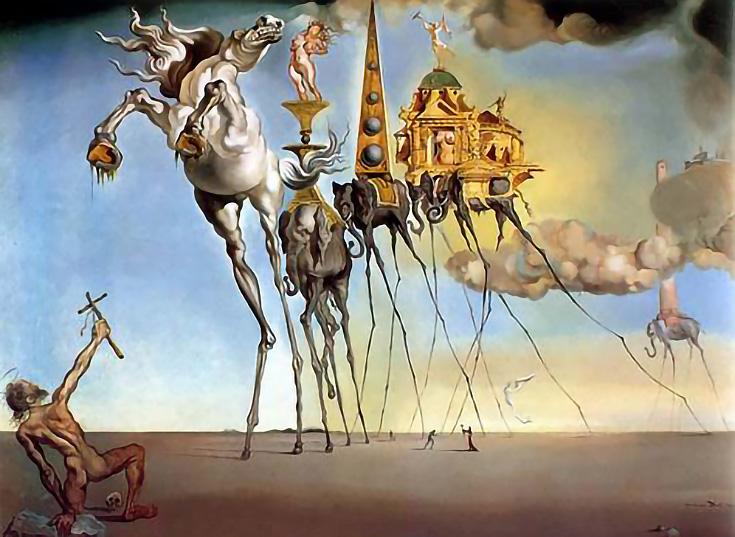
This picture had caught my eye during class. The horse looks especially demonic. At the same time, it looks majestic. The man wielding the cross, whom I would presume to be St. Anthony seems to be warding off these godlike creatures of nature. At the same time, he is warding off the woman that is riding on top of the elephant. This scene makes a lot more sense when I learned the title of the work: The Temptation of St. Anthony, which I did not know during my search (as you can imagine that made it tricky to find the picture). Then a little bit of research revealed to me that the temptation that St. Anthony faced while in the Egyptian desert is a popular theme in art. That means that St. Anthony is trying to ward off these creatures which may be pagan gods. I think it is fascinating how majestic and terrible a little bit of surrealist distortion can make these animals. This picture is a very awe-inspiring work of art.
Friday, April 9, 2010
Henri Matisse: Woman with a Hat

This colorful painting done from 1905 by Henri Matisse demonstrates the increasing emphasis on color that took place during the "Fauves" movement. I find it interesting to see how many different colors are used on each object. The face has six or seven different colors on it, and that is not including the features such as eyes or her mouth. Still, her face is very distinct and it is not hard to picture what the model for this painting may have looked like.
Her face is sandwiched between two dark features of the painting, her body and her hat. This makes the face the artistic focus of the painting, but many people who look at the painting question the nature of her hat. The fact that it is so big makes me think it is one of those fruit hats. However, its dark colors seem to contradict this assumption. The features are very blurry and distorted, so it is impossible to say what it is for sure. This is probably by design. I am sure that many artists like to have an element of mystery in their paintings. If I had to take a guess, I would say it was a fruit hat, and it was given darker colors to give an overall balancing effect to the painting, with the bright face in the center of the painting.
20th Century Music
Being a musician, I am somewhat familiar with the music of the 20th century. I can also attest to the dissonant nature of this music. Each part, when played by itself makes no sense compared to what I am used to hearing from playing classical composers and even current artists. When it is all put together, though, it sounds amazing. I used to think that was due to the talents of the composers who were able to pull off a pleasing sound made up of chaotic, interwoven parts. If it caused riots at its introduction, that might not be the case. I might be used to hearing that kind of music. Still, there must be some talent involved because some of the stuff I have heard just sounds terrible. Unless my ear is not as adjusted as I would like to think, which I will admit could very well be the case.
Of course for the same reason, that is my background as a musician, I can see why people would have started to break the "rules" of composing. In music theory, we have learned that early music was all written for the church and certain conventions must be followed by these composers. Staying inside these rules results in a limited amount that one can do with music. That means that after a while, it would become impossible to write a song that does not sound like the work of an earlier composer. Being new meant being different to the popular taste. This is probably true in any field of art.
Of course for the same reason, that is my background as a musician, I can see why people would have started to break the "rules" of composing. In music theory, we have learned that early music was all written for the church and certain conventions must be followed by these composers. Staying inside these rules results in a limited amount that one can do with music. That means that after a while, it would become impossible to write a song that does not sound like the work of an earlier composer. Being new meant being different to the popular taste. This is probably true in any field of art.
Subscribe to:
Posts (Atom)
